
Traveling alone can look intimidating when you’re planning it from home. There is no travel partner to check the map, watch your luggage while you buy a ticket, or make a decision when the train is delayed. Every small choice belongs to you.
That sounds like a lot of responsibility. In practice, it can also make travel remarkably straightforward. You choose where to go, set your own pace, change your plans when you want and spend a day exactly as you please. The trick is knowing what deserves preparation and what can be left open.
For a first solo trip, you don’t need a perfect itinerary. You need a sensible destination, a comfortable place to stay, a way to access your money and documents, and a plan for getting through the first day. Once those pieces are in place, the rest becomes much easier.
Why Solo Travel Needs a Different Kind of Planning
When you’re traveling with other people, decisions are shared. Someone else may notice that the last train leaves early, remember the hotel name, or suggest taking a taxi instead of walking with luggage. Alone, you have to notice those things yourself.
That doesn’t mean planning every hour. In fact, overplanning can make a solo trip unnecessarily rigid. A better approach is to prepare for the parts of travel where a mistake would be expensive, difficult or stressful, then leave ordinary sightseeing flexible.
Before you leave, know how you’ll get from the airport or station to your accommodation, where you’ll sleep on the first night, how you’ll access money and what you’ll do if your phone stops working. Those details create a safety net without turning the trip into a military operation.
Choose Your First Destination Carefully
Your first solo destination doesn’t have to be the most adventurous place you can find. A city with reliable public transportation, plenty of accommodation, easy access to food and services, and information available in a language you understand can make the learning curve much gentler.
Think about the kind of independence you want to practice. A compact city may be easier if you want to walk between neighborhoods and attractions. A destination with good rail connections can work well if you’re more interested in moving between places. If you’re uncomfortable driving abroad, don’t choose a destination where a rental car is practically essential.
Your own travel habits matter too. Someone who enjoys wandering through museums and cafés may find a city particularly easy to explore alone. Someone who prefers remote beaches, hiking or road trips may need more preparation around transport, communication and emergency planning.
For your first trip, choose a destination that gives you room to learn rather than one that forces you to solve difficult logistical problems from the moment you arrive.
Plan the First Day, Not Every Day

The first few hours are usually the most awkward part of a solo trip. You’re tired, unfamiliar with the surroundings and still figuring out how everything works. Give yourself fewer decisions to make.
Have the accommodation address saved offline. Know how you’re getting there from the airport, railway station or bus terminal. Keep your passport and payment method accessible but secure. If possible, arrive with enough daylight to get oriented rather than deliberately making your first arrival as difficult as possible.
The rest of the trip can remain loose. You might discover a neighborhood you want to explore, decide to stay longer at a museum or spend an afternoon doing absolutely nothing. Solo travel gives you permission to change your mind.
A useful itinerary might therefore contain only a few fixed elements: your arrival arrangements, accommodation, important bookings and any time-sensitive activity. Everything else can move.
Where You Stay Matters More When You’re Alone
A cheap room in an inconvenient location can be manageable when two or three people are splitting transport and navigating together. Alone, location becomes much more valuable.
Look at the neighborhood as carefully as the room. Consider how you’ll reach it with luggage, whether you can easily find food nearby, how late public transportation operates and whether you’ll feel comfortable returning there after an evening out.
For many first-time solo travelers, a well-reviewed hotel, hostel with private rooms, guesthouse or reputable apartment can work well. The right choice depends on your budget and the destination, but reliable communication and a practical location are often worth paying slightly more for.
Save the accommodation details somewhere other than your email inbox. An offline note containing the name, address and contact information can be useful if your mobile connection disappears at the exact moment you need it.
Packing for One Person Changes What You Should Pack
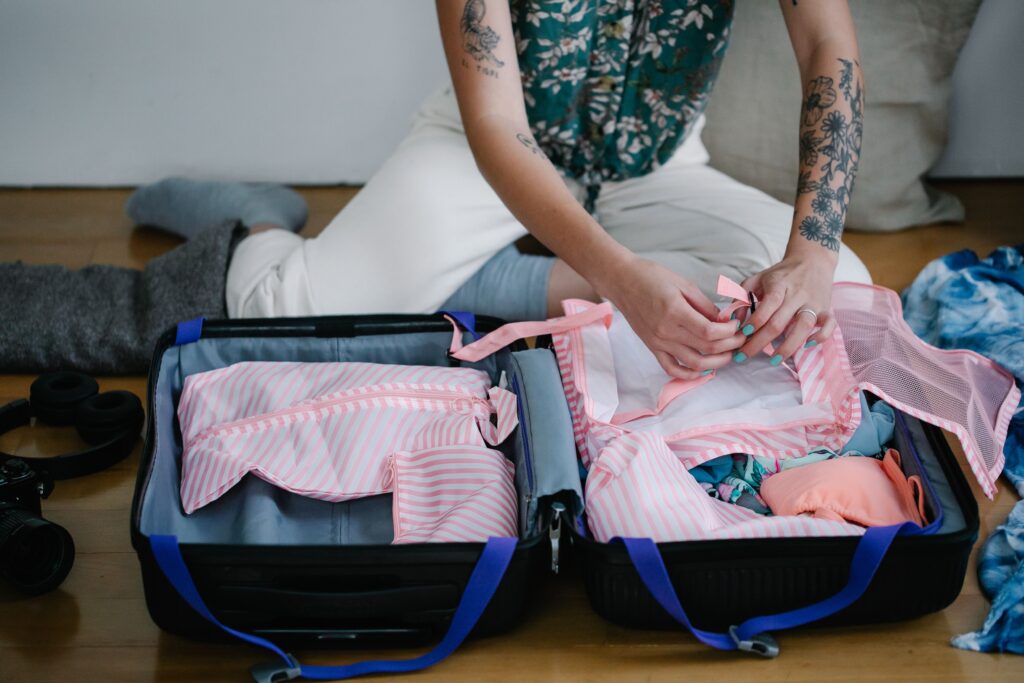
Packing lists rarely account for the fact that when you travel alone, you’re also the one carrying everything, watching all of it, and managing it without help. That changes the calculation. A bag you can comfortably carry for twenty minutes at a stretch, on stairs, without assistance, matters more than fitting in one extra outfit.
Favor fewer items that work in combination over a full wardrobe for every scenario. A daypack that can be worn on the front in crowded areas, a way to secure your bag while sleeping on overnight transport, and a portable charger are worth more than most of what ends up on generic packing lists. The less you’re managing physically, the more attention you have left over for actually paying attention to where you are.
Meeting People Without Forcing It
Loneliness on a solo trip is usually intermittent rather than constant, and it tends to show up in specific situations: a long solo dinner in an unfamiliar city, an evening with nothing planned, a moment of homesickness after a long travel day. Knowing that in advance makes it easier to handle when it arrives, rather than mistaking it for evidence that the trip is going wrong.
Hostels remain one of the more reliable ways to meet people casually, even for travelers who wouldn’t otherwise choose hostel-style accommodation, simply because communal spaces create natural, low-pressure conversation. Group activities like walking tours, cooking classes, or multi-day tours also put you around other people without requiring you to strike up a conversation from nothing.
None of this works if it’s forced. The travelers who end up isolated on a solo trip are often the ones trying too hard to avoid ever being alone, rather than the ones who let some solitude happen and stay open to conversation when the opportunity comes up naturally.
Eating Alone Is a Skill, Not Just a Logistics Problem
Eating alone is the specific moment that derails more first solo trips than almost anything else, mostly because it feels more exposed than it actually is. In most places, a solo diner draws far less attention than the traveler assumes. Bringing a book, journal, or simply sitting somewhere with a view of the street removes the awkwardness of having nothing to do with your hands or your eyes.
In some cultures, solo dining is genuinely unremarkable and common, particularly in much of East Asia, where counter seating and single-portion meals are built into the dining culture. In others, it draws more curiosity, which is worth knowing before your first meal alone rather than discovering it mid-dinner and reading too much into it.
Common Mistakes First-Time Solo Travelers Make
A few patterns show up often enough to be worth naming directly:
| Mistake | Why it backfires | Better approach |
|---|---|---|
| Overplanning every hour | Removes the flexibility that makes solo travel worthwhile | Fix only the time-sensitive bookings, leave the rest loose |
| Choosing a destination for the photos, not the logistics | Adds unnecessary difficulty on a first trip | Prioritize transport and language ease for trip one |
| Avoiding all discomfort | Solitude and loneliness aren’t the same thing, and some discomfort is part of adjusting | Let some quiet moments happen instead of filling every gap |
| Ignoring solo supplements when budgeting | Leads to unpleasant surprises on hotel and tour costs | Research per-person pricing before comparing trip costs to group travel |
None of these mistakes are dangerous. They’re just the difference between a trip that feels effortful the whole way through and one that settles into a rhythm after the first day or two.
A Practical Solo Travel Checklist
A few days before departure, check the things that would be difficult to fix after you’ve left.
Before leaving home:
- Check passport validity and entry requirements.
- Confirm accommodation and important transport bookings.
- Save important addresses and reservations offline.
- Arrange access to mobile data.
- Tell someone your basic itinerary.
- Check travel insurance coverage.
- Prepare backup payment options.
- Save emergency and local contact information.
- Check destination-specific safety and transport information.
- Make sure your phone, power bank and other essential electronics are charged.
You don’t need to pack for every imaginary emergency. Take the items that genuinely support the trip you’re taking.
TravelTheory Editor’s Note
The most useful solo travel skill is judgment. Know what needs to be booked, what needs to be checked, what information should be kept offline and when a situation simply isn’t worth the risk. Once those decisions become familiar, traveling alone becomes less about managing uncertainty and more about having control over your own time